US Sweepstakes Casino Operators Confront Shrinking Market Map as State Bans Take Hold in 2026
Yara Krause · May 30, 2026

US Sweepstakes Casino Operators Confront Shrinking Market Map as State Bans Take Hold in 2026
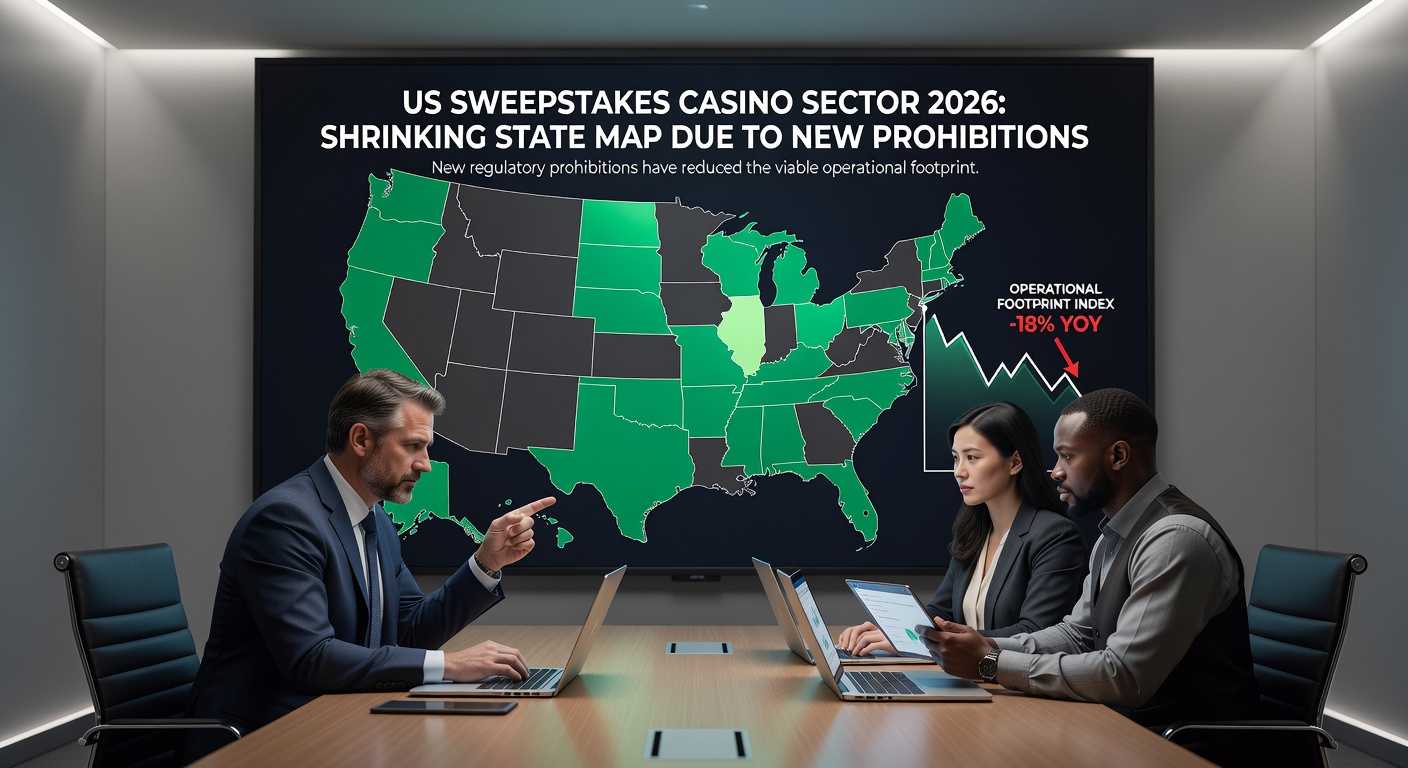
California’s Assembly Bill 831 took effect on January 1 2026 and removed sweepstakes casino operations from the state while Indiana’s House Bill 1052 is scheduled to follow on July 1 2026, and together these measures have reduced the number of states where such platforms can operate under existing dual-currency models. Observers note that the California prohibition alone removed an estimated one-fifth of national revenue for the sector, and operators have responded by exiting affected jurisdictions, adjusting product lines, and revising marketing approaches amid ongoing regulatory scrutiny and litigation.
California Prohibition Reshapes Revenue Landscape
Assembly Bill 831 ended the legal framework that previously allowed sweepstakes-based casino platforms to function in California, and the change took place at the start of 2026 after the bill advanced through the state legislature in the prior session. Data from industry tracking services shows that platforms previously active in the state generated roughly 20 percent of total national sweepstakes casino revenue before the prohibition, and the sudden absence of that market has prompted companies to reallocate resources toward remaining jurisdictions. Those who have studied the transition report that several major operators ceased all California-facing promotions by late December 2025, while others initiated legal challenges that remain pending in state courts.
Indiana Legislation Adds Further Pressure
House Bill 1052, passed during the 2025 legislative session, mirrors the California approach by prohibiting sweepstakes casino mechanics that rely on dual-coin systems, and the measure becomes enforceable on July 1 2026. As of May 2026 operators have already begun preparing for the Indiana deadline by scaling back advertising campaigns and reviewing user agreements for residents of the state. Figures released by state gaming regulators indicate that Indiana previously accounted for a smaller but still meaningful share of sweepstakes activity, and the combined effect of the two bans has accelerated discussions about long-term platform viability in other jurisdictions that may consider similar restrictions.
Operator Responses Include Market Exits and New Brand Launches
Virtual Gaming Worlds, the parent company behind Chumba Casino and several related platforms, has publicly confirmed its withdrawal from both California and Indiana, and the company has redirected development efforts toward new products that avoid dual-currency mechanics. One such offering, Just Slots, operates without the gold-coin and sweepstakes-coin structure that defined earlier titles, and company statements describe the shift as a direct response to the changing regulatory environment. Additional operators have followed similar paths, with some choosing to exit entire states rather than maintain separate compliance teams for each jurisdiction.
Marketing strategies have also changed, and companies now emphasize single-currency gameplay or social features that fall outside the sweepstakes definition in restricted states. Payment rails have required updates as well, since certain processors have adjusted their policies in response to the new state laws, and operators report working with alternative providers to maintain transaction flows for users in permitted markets.
Regulatory and Litigation Environment Continues to Evolve
Legal challenges filed by multiple companies argue that the state prohibitions exceed existing authority over sweepstakes promotions, and court proceedings in both California and Indiana remain active as of May 2026. Industry associations have submitted amicus briefs outlining the economic impact on small businesses that previously supported the platforms through marketing and affiliate programs. State attorneys general have countered that the legislation targets gambling-like activity that previously operated without direct oversight, and the resulting tension has produced a patchwork of enforcement approaches across remaining states.
Adaptation Patterns Emerge Across the Sector
Companies that continue operating have consolidated user bases in states without new prohibitions, and some have introduced loyalty programs that do not rely on sweepstakes entries. Data shared by platform analytics firms shows increased session lengths in permitted jurisdictions, while acquisition costs have risen because marketing channels must now exclude residents of California and, after July, Indiana. Observers tracking these metrics note that the sector has begun testing hybrid models that blend social casino elements with limited sweepstakes features in an effort to stay within evolving legal boundaries.
Conclusion
The combined impact of Assembly Bill 831 and House Bill 1052 has narrowed the operational map for sweepstakes casino platforms entering the second half of 2026, and operators have responded with state exits, new product development, and revised compliance structures. Virtual Gaming Worlds and similar companies continue to adjust their offerings while litigation proceeds, and the sector now operates under a smaller set of state rules that will likely shape future product design and market strategy.